Choosing where your application lives is one of the biggest technical decisions you will make. Two options often come up: a dedicated server and a PaaS platform. They sit at opposite ends of the “control vs convenience” scale, and both are good in the right situation.
Quick answer: A dedicated server gives you a whole physical machine for your own use, with full control and steady performance, but you manage the setup and upkeep. PaaS gives you a managed platform where the provider handles servers, updates and scaling, and you focus on your code. Pick a dedicated server for heavy, steady or highly custom workloads. Pick PaaS for faster launches and changing traffic.
If PaaS is new to you, read our simple guide on what PaaS is first.
What Is a Dedicated Server?
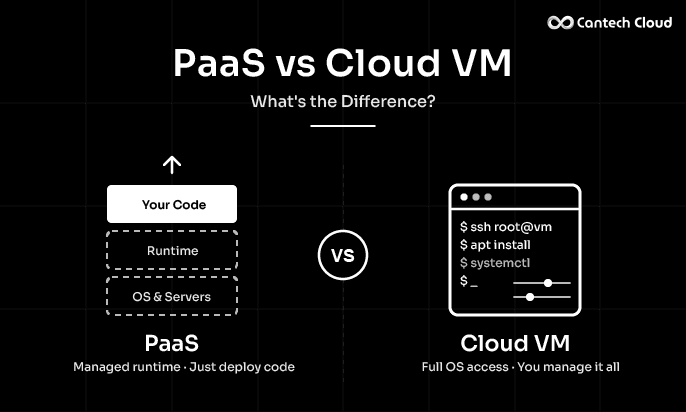
A dedicated server is a physical server rented by one customer. No one else shares its CPU, memory or disk. You choose the operating system, install your software and tune the machine the way you want.
Where dedicated servers shine:
- Full control over hardware level choices and software
- Steady, predictable performance
- Strong fit for heavy workloads such as large databases or high traffic platforms
- Good for special software or strict setup needs
Our sister brand Cantech offers dedicated servers for teams who need this kind of power and control.
What Is PaaS?
PaaS is a managed platform for building and running applications. The provider manages servers, the operating system, runtime updates, security patching and scaling. You push your code and connect your database.
Where PaaS shines:
- Quick setup and deployment
- Less day to day maintenance
- Scaling that can adjust with traffic
- Managed databases and storage
You can explore this on our PaaS platform, and learn how it runs in our guide on how PaaS works.
PaaS vs Dedicated Server: Side by Side
| Feature | Dedicated Server | PaaS |
| Control | Very high | Moderate |
| Who manages the server | You | The provider |
| Setup time | Longer | Short |
| Performance | Steady and predictable | Depends on plan and scaling |
| Scaling | Usually manual, by upgrading or adding servers | Can be automatic |
| Maintenance | Done by you | Mostly handled by the platform |
| Skills needed | Server administration | Mostly application development |
| Cost style | Often fixed monthly | Often based on usage |
| Best for | Heavy, steady or custom workloads | Fast moving, changing workloads |
How They Compare on Key Questions
Control
A dedicated server wins here. You can install almost anything and tune the system deeply. PaaS works best with common stacks such as PHP, Laravel, Node.js and Python, and limits low level changes on purpose so the platform can stay stable.
Time and effort
A dedicated server needs regular care: updates, backups, monitoring and security. If you have a skilled team, this is a normal part of the job. If you do not, PaaS gives that time back.
Scaling
With a dedicated server you plan capacity in advance. If traffic jumps beyond the machine, you upgrade or add another server. PaaS is built to add and remove resources as demand changes.
Cost
A dedicated server often has a fixed, predictable bill, which can be very cost effective when you use the machine heavily and steadily. PaaS often follows usage, which can suit changing traffic. Neither is always cheaper. See how our plans work on the PaaS pricing page.
Databases and storage
On a dedicated server you install and maintain the database yourself. On PaaS, our managed databases can take care of much of that, including MySQL hosting, PostgreSQL hosting, MariaDB hosting and MongoDB hosting. For files and media, see our file storage and storage services.
When a Dedicated Server Is the Better Choice
- Your workload is heavy and runs at a steady level
- You need custom software or deep system tuning
- You want full, exclusive use of the hardware
- You have the team to manage the server
- You prefer one predictable monthly cost
When PaaS Is the Better Choice
- You want to launch quickly
- Your traffic goes up and down
- You do not have a dedicated server administrator
- You deploy updates often
- You want managed databases and less upkeep
- You run a stack such as PHP or Laravel
Can You Use Both?
Yes. Many businesses run their main application on PaaS for easy scaling, and keep heavy or special workloads on dedicated servers. You can also start with PaaS and move parts of your system later as your needs become clear. For a wider look at cloud and physical options, read our post on cloud compute vs bare metal. To see which projects fit PaaS best, read our guide on PaaS applications.
CANTECH CLOUD PAAS
Not Sure Which Infrastructure Fits Your App?
Tell our experts about your workload and we will help you choose between a managed platform and other options.
Final Thoughts
Dedicated servers give you power and control. PaaS gives you speed and less upkeep. The right choice depends on your workload, your team and how much you want to manage yourself. Many businesses use both, each where it fits best.
Want to see how PaaS could work for your application? Explore our PaaS platform or talk to our team.
Frequently Asked Questions
Is a dedicated server faster than PaaS? A dedicated server gives you exclusive hardware, so performance is steady. PaaS performance depends on the plan and how the platform scales. The better choice depends on your workload.
Is PaaS cheaper than a dedicated server? Not always. A busy, steady workload can be very cost effective on a dedicated server. A changing workload may be more efficient on PaaS.
Can I move from a dedicated server to PaaS? Yes, many teams do. Plan the move carefully, including your data, settings and any special software.
Which is better for beginners? PaaS is usually easier because there is less server setup to learn.