People often ask “Should I use PaaS or Docker?” The question sounds fair, but it mixes two different things. Docker is a tool. PaaS is a service. Once you see that, the choice gets much easier.
Quick answer: Docker is a tool that packages your app and everything it needs into a portable container. PaaS is a managed platform that runs your app for you and handles servers, updates and scaling. They are not rivals. You can use Docker to build your app, and a platform to run it.
New to PaaS? Read our guide on what is PaaS first.
What Is Docker?
Docker lets you put your application, its libraries and its settings into one package called a container. That container runs the same way on your laptop, on a test server or in production. This fixes the classic problem of “it works on my machine”.
Good things about Docker:
- Your app runs the same everywhere
- Easy to share and reproduce environments
- Great for teams with many services
- Works with almost any language
Things to think about:
- Docker packages your app, but it does not run a whole production setup by itself
- You still need somewhere to run containers
- You still need to handle networking, scaling, security and updates
What Is PaaS?
PaaS is a managed platform for building and running applications. The provider handles servers, the operating system, runtime updates, patching and scaling. You push your code, connect a database and go live.
You can see this on our PaaS platform, and learn the steps in our guide on how PaaS works.
An Easy Way to Picture It
Docker is like a lunchbox. It packs your food neatly so you can carry it anywhere. PaaS is like a canteen. It gives you a table, a kitchen and cleaning, so you can simply eat. You can bring a lunchbox to a canteen, and they work well together.
PaaS vs Docker: Side by Side
| Feature | Docker | PaaS |
| What it is | A container tool | A managed platform |
| Main job | Package apps into containers | Run, scale and manage apps |
| Who manages servers | You, or another service | The provider |
| Scaling | You set it up elsewhere | Often built in |
| Learning curve | Medium | Low to medium |
| Control | High over the app package | Moderate over the platform |
| Best for | Consistent environments and portability | Fast deployment with less upkeep |
Key Differences in Practice
Scope
Docker solves one problem very well: packaging. PaaS solves a bigger problem: running your app in production without server work.
Effort
With Docker alone, you must decide where containers run and how they are connected, secured and scaled. With PaaS, those choices are handled for you.
Portability
Docker shines here. A container can move between environments easily. PaaS can be more tied to the way a platform expects apps to be built, though common stacks are usually simple to move.
Databases and storage
In either approach your app needs data. Our managed databases include MySQL hosting, PostgreSQL hosting, MariaDB hosting and MongoDB hosting. For files, see our file storage.
When Docker Is the Better Choice
- You need the same environment on every machine
- Your app has unusual dependencies
- You run many small services
- Your team is comfortable with containers and DevOps
- You want an app that is easy to move between providers
When PaaS Is the Better Choice
- You want to launch quickly
- You do not want to manage servers or container setups
- Your app runs on a common stack such as PHP or Laravel
- You deploy often and want less manual work
- Your team is small
Using Docker and PaaS Together
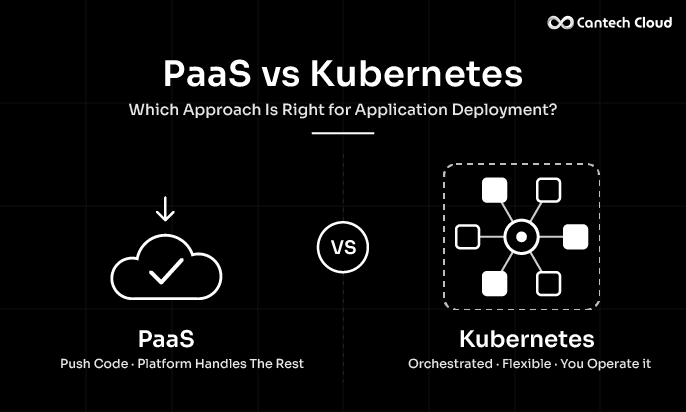
Many teams do both. They build and test with Docker locally, then deploy to a managed platform that takes care of the rest. If your project grows into many containers that need managing, you may also look at orchestration. Our post on PaaS vs Kubernetes covers that step, and our guide on PaaS vs CaaS explains container focused services.
Final Thoughts
Docker and PaaS are not competitors. Docker packages your app. PaaS runs it. Use Docker when you need portability and consistency, use PaaS when you want speed and less upkeep, and use both when it makes sense.
Want to see how a managed platform feels? Explore our PaaS platform or talk to our team.
Frequently Asked Questions
Is Docker a PaaS? No. Docker is a container tool. Some platforms are built around containers, but Docker alone does not give you a managed platform.
Can I run Docker containers on PaaS? Some platforms support it and some do not. Always check what your chosen platform allows.
Is PaaS easier than Docker? For running an app in production, usually yes, because the platform handles servers and scaling.
Do I need Docker to use PaaS? No. Many PaaS apps are deployed straight from code without Docker.